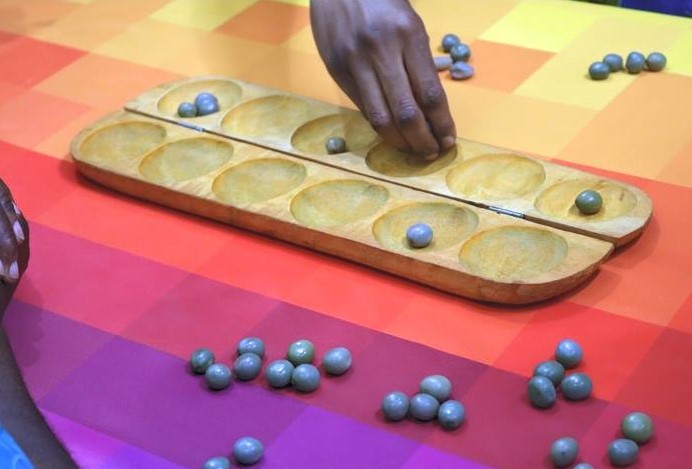
Ayò--The Game of the Intellectuals
Traditionally known as Ayò Ọlọ́pọ́n, this African board game is often referred to as “The Game of the Intellectuals.” Ayò (pronounced aah-yoh) is a traditional game played by the Yoruba people of South Western Nigeria. Unknown to many, this game requires considerable brainpower and mathematical skill.
Ayò is played in a carved wooden box containing twelve holes (six holes on each side) and 48 Ayo seeds (four seeds per hole). It is similar to the Oware game, known across the Americas — a game originally introduced by slaves from Africa. Ayò is of Yoruba origin, though it has historical ties to the Warri tribe, whose ancestors were traded alongside the Yoruba before the abolition of the slave trade. Surprisingly, Ayò shares identical rules with Endodoi, played by the Maasai people of Kenya and Tanzania.
Traditionally, the game is played in the evening after a day’s work. In Yoruba culture, there was a belief that only lazy men played it during the day. Interpretation: Ayò means "seeds" and Ọpọ́n means "holder," so together, Ayò Ọlọ́pọ́n translates to “Seeds in the Holder.”
How the game is played: Two players sit opposite each other and play in an anti-clockwise direction. The first player moves seeds from the right-hand side to the opponent’s side. If the movement ends in a hole with three or fewer seeds, the player collects those seeds along with seeds from preceding holes. Players alternate turns until all seeds are exhausted. The winning player is called Ọ̀ta (knowledgeable), and the losing player is called Ope (ignorant/loser). Spectators’ comments often add excitement to the game.
Ayò is not just about moving seeds — it requires deep thought and strategy. One wrong move could give the advantage to an opponent. In some regions, children are encouraged to play Ayò as it sharpens mathematical skills and teaches real-time strategizing.
Some believe Ayò has spiritual significance. It is sometimes played in houses of mourning to entertain the spirit of the deceased. During these times, it is considered unlucky to play at night, as spirits may want to join in. Two types of boards may be used: one with a flat top and another curved like a banana. When a man dies, villagers play on the board that was not his favorite so his spirit does not interfere.
COURTESY: GOOGLE
How much do you know about your community? 🤗 Watch this space 😁 Let's create a story with this game! 😌 Who's game? 🤔 A duet?
#He-Benny